Thursday, November 12, 2015

They're paws! Paws, I say!

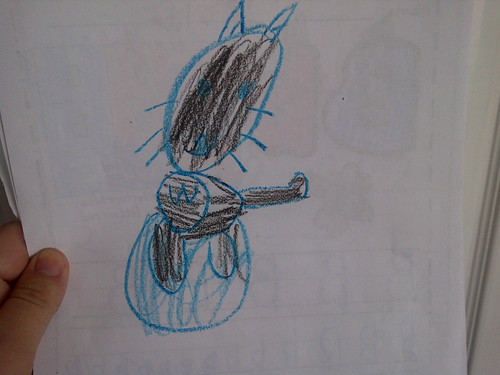
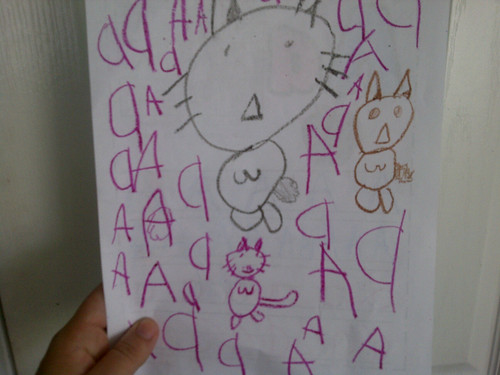
When Daisy started kindergarten a few months ago, she drew pictures of kitties and bunnies on the backs of all of her school papers. I loved this so much, and I'm sad that she's already grown out of it a bit.

image 

image

image

She still draws kitties and bunnies by the masses, just not on her schoolwork.

A question arises about what is on the chests of all of these creatures. Paws, of course!

"But they don't have claws," says my nameless sister-in-law.

They've been de-clawed. 
 

Monday, November 9, 2015

Covenants and the Return


"The divine plan of happiness enables family relationships to be perpetuated beyond the grave. Sacred ordinances and covenants available in holy temples make it possible for individuals to return to the presence of God and for families to be united eternally."

The topic for today is one I fear I can never adequately address. I've touched on the subject before, but I worry that my perceived naivety inhibits my message to some extent. Also, it's such a vast topic (as I'm discovering is true for all of the things I've written about for this Proclamation project). How do I write only a few short words and make them meaningful? And how do I articulate what I truly want to say on the matter? 

The subject I'm referring to is that of lost children. Not the ones who have passed from this life, but the ones who have become involved in serious transgression or who have strayed from the values that parents have worked so hard to instill in them. 

There are so many levels on which this can happen. This is where the subject begins to become broad. One family's situation may involve a child who simply doesn't believe the same things as the parents but who still remains close to the family. Another family may have a child who has become a slave to addiction, who has abused a spouse or child, who has become involved in criminal activity, or who has completely left the family. 

I don't want to try and define what constitutes a "lost child" because I believe it's very different for each family, so suffice it to say that there are often situations in which parents are confused or heart-broken about the way their children use their agency, and that is what I'm writing about today.

In the Church of Jesus Christ of Latter-Day Saints, we have the opportunity to live in a way the qualifies us to enter the temple of the Lord and to be sealed as a family (read more about temples here). To be sealed means to be united as husband and wife for eternity. During the sealing ceremony, husband and wife make covenants or promises to each other and to God. We believe that if we keep those covenants, we'll be able to return to the presence of God after this life and continue to live as families.

It's the fear of losing a child in the eternities that is most heartbreaking to a family. As a member of the Quorum of the Seventy, Elder John K. Carmack explained:

Typical and normal parental reaction [to family problems with wayward children] include sorrow, despair, desperation, depression, feelings of guilt and unworthiness, and a sense of failure. In such circumstances, parents may also experience anger and withdrawal and may feel like simply giving up (1997). 

I love this quote by Dr. Glenn Latham:

Well-meaning parents who have tried their best should avoid the temptation of using their child's behavior as the measure of their success as parents. If children's behavior were the sole measurement of good parenting, our heavenly parents would not qualify. They lost a third of their children before mortality was even available, and very probably countless more. Remember this: perfect parents make no mistakes; imperfect parents do. Both have children who stray.

(I recommend Dr. Latham's book Christlike Parenting for further reading).

Our Heavenly Father knows, more than anyone, the pain of having children who exercise their agency in a manner that is contrary to a parent's hopes and dreams. I don't think His intention is for parents to be wracked with guilt and devastation. One mother expressed her feelings as follows:

I think that God created the family unit as part of the divine plan to have his children return to Him. I don't think it's to create a feeling of despair when a loved one strays from the gospel; I think it's to create a feeling of urgency on our part to help that son or daughter come back - to keep ourselves in high, firm ground, so that we can reach out to one who does not have as firm a footing on gospel ground. Although a connection to God may be broken, a line of communication and love through us remains (Pehrson, Cook, and Madsen, 2012). 

We want the comfort of knowing our children are safely returned to the fold, which is why we feel such an urgency, but we can not coerce or take control of another person's agency. Covenant keeping is the key. It's those very promises we make to God in the temple that will bind our families and bring back those who stray. Joseph Smith said, "When a seal is put upon the father and mother, it secures their posterity, so that they can not be lost, but will be saved by virtue of the covenant of their father and mother" (Teachings of the Prophet Joseph Smith, 1976).

This is a principle that is often discussed but perhaps not fully understood. I feel that I'm only beginning to comprehend the role of temple covenants in this way.

President James E. Faust declared:

Perhaps in this life we are not given to fully understand how enduring the sealing cords of righteous parents are to their children. It may very well be that there are more helpful sources at work than we know. I believe there is a strong familial pull as the influence of beloved ancestors continues with us from the other side of the veil... To those broken-hearted parents who have been righteous, diligent, and prayerful in the teaching of their disobedient children, we say to you, the Good Shepherd is watching over them. God knows and understands your deep sorrow. There is hope (2003).

Elder Orson F. Whitney promised:

The Shepherd will find his sheep. They were his before they were yours - long before he entrusted them to your care; and you can not begin to love than as he loves them. They have strayed in ignorance from the Path of Right, and God is merciful to ignorance. Only the fullness of knowledge brings the fullness of accountability. Our Heavenly Father is far more merciful, infinitely charitable, than even the best of his servants, and the Everlasting Gospel is mightier in power to save than our narrow finite minds can comprehend (1929).

The Book of Mormon teaches that the Atonement is infinite (Alma 34:10, 14). This provides assurance that there is no limit to Christ's capacity to cover the sins of every type, severity, and frequency. The Atonement is in force both in this life and and in the life to come, though we are warned that deliberately delaying our repentance places our eternal reward in jeopardy (Alma 34:31-35). Even with the dangers of willful disobedience, the prophets have promised that even the most disobedient of children can be saved through eventual repentance by virtue of the Atonement. The obedience of parents to their temple covenants will one day be rewarded (Pehrson, Cook, and Madsen, 2012). 


Elder Whitney also taught:

The Prophet Joseph Smith declared - and he never taught more comforting doctrine - that the eternal sealings of faithful parents and the divine promises made to them for valiant service in the Cause of Truth, would save not only themselves, but likewise their posterity. Though some of the sheep may wander, the eye of the Shepherd is upon them, and sooner or later they will feel the tentacles of Divine Providence reaching out after them and drawing them back into the fold. Either in this life or the life to come, they will return. They will have to pay their debt to justice...and may tread a thorny path; but if it leads them at last...to a loving and forgiving father's heart and home, the painful experience will not have been in vain. Pray for your careless, disobedient children; hold on to them with your faith. Hope on, trust on, till you see the salvation of God (1929).

President Henry B. Eyring added his testimony to this statement when he said, "The story of the prodigal son gives us all hope. The prodigal remembered home, as will your children. They will feel your love drawing them back to you" (2009).

I haven't yet had the experience of a child leaving the fold, but I have many loved ones I hope will return someday. I don't fully understand the role of temple covenants in bringing God's wayward children back to Him, but in God's plan of Happiness, there is a return. Everything we do and everything we believe helps direct us back to Him. The return is important, and God has enlisted His children on both sides of the veil to work toward this cause. Every temple ordinance that is performed creates a connection to God, and there are many great things at work that we can not see.
 
-----------------------------------------------
This post was inspired by "They Cannot Be Lost: Temple Covenants Save Families," by Kyle L. Pehrson, Ron Cook, and Nancy L. Madsen, published in Successful Marriages and Families: Proclamation Principles and Research Perspectives, 2012. This piece of writing is part of my Family Proclamation project for FAML 100 at Brigham Young University Idaho. 

Friday, November 6, 2015

The Terrible Thing I Did

A year ago, something terrible happened. I've never mentioned it here on the blog because I've needed some time to cope. 

A year ago today, my sister-in-law, Chelsea got married.

Oh! But that's not the terrible thing.

The terrible thing, which a year later, I'm finally ready to talk about, is that I destroyed the wedding cake.

Yes.

Me.

I did this:

image

I took on the responsibility to pick up the cake and transport it to the wedding reception. In hindsight, there are so many things I should have done differently, first and foremost, I would now ask the baker to assemble the cake on location.

I did everything I could to get the cake there in one piece, but it didn't happen.

I am a bona fide cake wrecker!

Fortunately, Chelsea is pretty laid back. She thought it was hilarious. They threw some flowers on it, tried to fake a few photos with a friend hiding behind the cake holding it up, and served the cake in piles on plates.

If there is anyone's cake I can get away with destroying, it's Chelsea's. Thank heaven for that!

But was still very shaken by the experience. To this day, my heart rate climbs when I drive on Cake Wreck Road (the route I took to the reception whereon the devastation occurred).

Dearest Chelsea, I'm sorry that I wrecked your wedding cake. I know you forgive me, and I'm very thankful for that. I'm also very thankful that you're a licensed social worker and capable of providing therapy to help me cope with the emotions that come with ruining someone's wedding cake.

Happy Anniversary, beautiful people!


Thursday, November 5, 2015

All of a Sudden It's November

My brain hasn't yet processed the fact that it's November. The other day my friend posted a link to a Thanksgiving family home evening lesson on facebook, and I had the same out-of-season reaction that I have when I see Valentine's Day candy on Easter. I thought, "That doesn't belong here!" because, in my subconscious, it's some other time of year. Certainly not Thanksgiving!

Then in hit me. BAM!

It is Thanksgiving season.

It's November.

And I was like...


I'm continually amazed at how fast time flies now that I'm an adult (with the exception of time spent pregnant, which stands stagnant and grows algae and contributes immensely to West Nile Virus).

It was just Christmas, wasn't it? I mean, I haven't even put all of my kids' presents away yet. The V-Tech jungle animal set that Zoe got last year is still sitting on top of the Barbie house where I placed it temporarily until I could reorganize the closet shelves.

No wonder my great-grandparents left their Christmas tree up all year long. It had nothing to do with them being old and immobile. They just knew they'd need to bring it out again in a few days, so why bother?

Wednesday, November 4, 2015

Grandparents, You Rock!


"Extended families should lend support when needed."

I am 31 years old (and close enough to 32 that I should probably round up), and I still have three living grandparents.

That's pretty incredible!

In 1900, the average life expectancy was only 49 years. Now it's 77 (Miller and Yorgason, 2012).  In 1900, less than 40% of people still had a living parent at age 50 (Uhlenberg, 1996). Currently, a 20-year-old is more likely to have a living grandmother (91%) than a 20-year-old was to have a living mother in 1900 (83%) (Miller and Yorgason, 2012).

With the increased life span of modern-days, we are blessed to have our grandparents around longer. What an amazing thing to have those lasting inter-generational relationships in this mortal journey.

Generations 1 
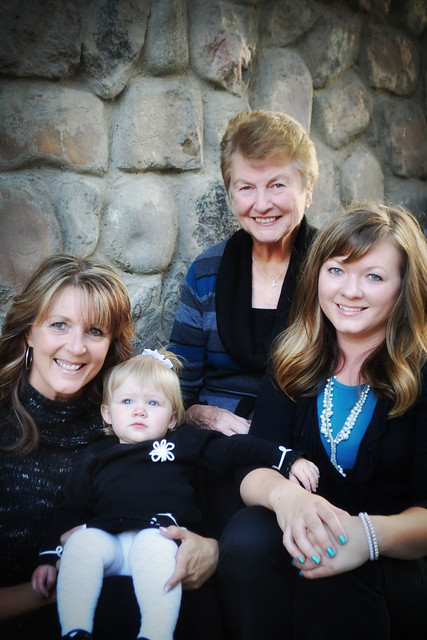
This is a four-generation photo with my 
grandma, my mom, myself, and Daisy. 
This is the only four-generation line 
of girls in my family.

When I was growing up, I had special relationships with my grandparents on both sides of the family. My grandparents were always involved in my life, and they played a very important role in my childhood.

When my parents got divorced, my dad moved in with his parents for a while. I had the chance to stay at my grandma's house with my dad on the weekends. This helped me see past some of the initial difficulties of going though a divorce. I got to sleep over at Grandma's house! All the time!

Shortly after the divorce, my mom moved into a house directly across the street from her parents' house. From the time I was seven years old, I could simply jot across the street to my grandparents' house any time I wanted, and I made a habit of doing this several times a week.

I wish I could name everything my grandparents have done for me throughout my life so I could adequately portray the magnitude of their influence, but the list is far too long. Suffice it to say that they have done countless good on my behalf, and I love them dearly.

My children have likewise been blessed with living grandparents. Lots and lots of them! Since both Scotty's and my parents are remarried, our children have four sets of grandparents. Our moms live in the same neighborhood we do, and our dads are both a short 15 minutes away.

We feel so fortunate to have them all so close. I don't know how I could ever raise these children without them! They provide traditions, unconditional love, and sometimes even refuge. They've saved my sanity countless times when I've been overwhelmed.

Plus, my kids adore their grandparents!

There are a lot of benefits to having grandparents involved in the lives of children. Children who experience emotional closeness to their grandparents are shown to have reduced acting-out behaviors such as sexual promiscuity, drug abuse, and delinquency. They have fewer symptoms of depression, and they have better prosocial behaviors such as wanting to help others (Miller and Yorgason, 2012).

Grandparents are truly a gift. I'm so grateful for the impact my own grandparents have had on my life, and I'm equally grateful for the role my children's grandparents are currently playing in their lives.

Grandparents, you rock! Thank you for all you do.

-----------------------------------------------
This post was inspired by "Supporting Families Across Generations," by Richard B. Miller and Jeremy B. Yorgason, published in Successful Marriages and Families: Proclamation Principles and Research Perspectives, 2012. This piece of writing is part of my Family Proclamation project for FAML 100 at Brigham Young University Idaho. 
Monday, November 2, 2015

The Truth About Three-Year-Olds

This post was originally published on May 7, 2013 when my daughter, Daisy was three. Today is Zoe's third birthday, so I thought I'd post it again in honor of the horror that is THREE. The biggest difference between Daisy and Zoe is that Zoe has a speech delay, so she hasn't learned to call me stupid yet. It's coming, though. Give it time...

-------------------------------------------------------------
 
Right now I am the mother of a three-year-old, and life with a three-year-old can be pretty tough. If you have a three-year-old, you're probably nodding sympathetically with your bottom lip turned down in a "yes-I-know" expression. If you've had a three-year-old in the past, you have probably experienced some sort of subconscious memory suppression as a healing mechanism. If you're going to have a three-year-old in the future, come back at that time and see if your life parallels mine.

Here are ten of the many ways that three-year-olds make life interesting:

1. They learn the words "hate" and "stupid," and they use them in ALL CAPS!

"STUPID Mommy!"

"I HATE ponies!"

"Being happy is STUPID!"

"Everything that is fun is STUPID!"

"I HATE everything that I loved yesterday!"

2. They still need naps but not until about 5:00 p.m, so there is this 2-3 hour window of each day where you have to fight to keep them awake. If you surrender to the much-needed sleep, don't try to wake them after only half an hour. The screaming ratio is 4:1, so a half-hour of sleep results in two hours of tantrums. You're better off leaving the child be and starting the next day at 3:00 a.m. when the child comes stomping in your bedroom asking for a brownie.

3. Everything that comes out of their mouths is contradicting and manipulative, and no matter what you do, you can not force them to see how illogical they are.

"I'm too full to eat my breakfast. Can I have a snack?"

4. They need to pee all the time. The less convenient the restroom facilities, the more immediate the urge to pee. They never need to go when you're standing ten feet away from a bathroom. It's always when you're at the farthest point possible with a shopping cart full of groceries. They have you book it back to the front of the store only to say, "Huh. Guess I don't need to go!" Then you get this mentality that the child WILL pee, or else! So you sit them on the toilet, point your finger, and say, "Pee! Now!" but "The pee won't come out, Mommy!" Ten minutes later, they wet themselves in the car.

5. They learn to lie. The experts assure you that this is a normal developmental milestone, but it is just one more thing that makes you want to pull your hair out. It doesn't matter what you saw or what proof you present, they will look you in the face and lie. You can watch them pee on their closet floor for the third time in one day, and the conversation will always go like this:

"You peed on your closet floor again!"

"No, I didn't."

"I saw you."

"I didn't pee."

"Then why is the floor wet?"

"It's water."

"How did the water get there?"

"From the hose."

"The hose is outside. How did the hose get water on the floor of your second-story closet?"

"Through the window."

"WHO IS YOUR LAWYER?"

6. They learn to use ultimatums. 

"If you don't let me eat thirty pounds of Easter candy before lunch, I will always HATE you, and I will never love you because you are STUPID Mommy!"

And they leave you wondering Is this what I sound like? Because surely they have learned this awful behavior somewhere.

7. No form of discipline works on them. You can count to three 'til you're blue in the face, and you will never be successful. You can give them a very clear warning about the consequences of their actions, and they do not care. Time out? Psht! Let's face it, they'd be in there ALL DAY. Loss of privileges? Get real. Love and Logic? Just one problem... three-year-olds HAVE NO LOGIC.

8. They make you desperate and have you doing all those things you swore you would never do. Especially in public.

You know how uncomfortable you feel when you hear a woman yelling at her kids in the middle of Costco? You know how you're kind of humiliated for her, and you totally judge her because she is proving in a public situation that she has no control over her children?

Yeah. That woman has a three-year-old.

Sometimes that woman is YOU.

9. They still do everything they did when they were two, but they are stronger, faster, heavier, and have a more extensive vocabulary.

10. There is always another one in queue. By the time you have lived to see age four, there is usually someone waiting in the wings to turn three.

I think the only thing that keeps me from burying my head ostrich-style in the backyard is the fact that one in ten things my three-year-old says is very sweet, loving, or funny. Maybe that one thing is worth it.

Maybe.

I'll tell you when she's four.

Why Fathers Matter

"By divine design, fathers are to preside over their families in love and righteousness and are responsible to provide the necessities of life and protection for their families."

Nine years ago, when we welcomed our first child, Nicky, into the world, I immediately noticed how attractive fatherhood made Scotty.

I mean, there was this man I was already deeply fond of, and he was holding a baby! And there was all this love emanating from him. Sure, he had no clue what he was doing, and his fears were palpable, but wow! There was all sorts of potential there, and he was hot stuff!

Then we had a daughter... and another daughter... and another!

And each time, I was like, "Don't go out in public holding that baby because the ladies are going to be all up in your grill!"

In September, while we were trucking our children around Las Vegas, there were several moments where I trailed behind and watched a scene just like this one:

image
That, my friends, is my husband, and he is amazing and four times as handsome as he was the day I married him.

Fatherhood looks good on him!

Fathers have a great influence on children and families. Jewish philosopher, Ambraham Hechel, identified fathers as teachers and holy figures in the lives of their children (Brotherson, 2012). That's a pretty heavy role to play in the life of another human being, and yet, it is such a honorable, sacred opportunity.

Good fathering doesn't simply impact your own children - it trickles down through posterity. John Snarey, author of How Fathers Care for the Next Generation said, "Good fathering, it seems, really does matter. It matters over a lifetime, and even over generations" (1993). That statement was the summary of a multi-decade research project that Snarey conducted on the contributions of fathers to children (Brotherson, 2012).

Children benefit greatly from having involved fathers who interact positively with them. This connection affects their cognitive development, their social competence, and their empathy (Brotherson, 2012). According to a report by the Fatherhood Institute, positive father involvement is associated with better peer relationships, fewer behavioral problems, lower criminality and substance abuse, higher educational/occupational mobility, more satisfying adult relationships, and higher self-esteem and life satisfaction (Maxfield, 2011) .The benefits are even greater when the father interacts positively with the mother, whether they are married to each other or not (Holmes, 2007).

Being a father involves many important principles, a few of which I'll touch on and refer to as The "4 P's" of Fatherhood.

The first is PRESIDING. This is a term that is very common in the Church of Jesus Christ of Latter-Day Saints. Merriam-Webster defines preside as "to be in charge of something." From that definition, it's easy to mistake presiding as being "the boss" or practicing dominion.

Presiding is a responsibility that goes far beyond power and control. They key words from The Family: A Proclamation to the World are "love and righteousness." A father is to be a spiritual leader in the home "through the gentle application of love and the consistent example of spiritual attentiveness..." (Brotherson, 2012).

In the Parenting and Child Guidance class I'm taking, we're reading a book called The 10 Basic Principles of Good Parenting. I have been pondering frequently over this statement, "Your authority over your child should be grounded in your experience, your knowledge, and your judgment, not in your power. Your child should respect you because you are the parent, but obey you because you are correct" (Steinberg, 2004). I think that statement is applicable to a father responsibility to preside in the family. A father (and likewise, a mother) should guide children with experience, knowledge, and good judgement, resulting in teaching good principles. We are meant to lead our children in a manner that helps them learn right from wrong. Parenting (and presiding) is not a power trip to be abused.

The next "P" is PARTNERING. Parenthood is a partnership (Brotherson, 2012). We've all heard the old phrase, "It takes a village to raise a child." I am constantly in awe at my own amazing village. My children have wonderful, involved grandparents who help us so much. They have aunts, uncles, and cousins... teachers and scout leaders... doctors and neighbors... and let's not forget God.

For fathers, being aware of these relationships is very important. Not only is a father a partner with the mother of the children, but a partner with all other involved parties. A fundamental principle in fathering is to partner with others in a broad system of relationships in raising a child (Brotherson, 2012).

Fathering thrives when it is supported by local and spiritual communities and men link themselves in partnership with those communities. Fathers and their children benefit as linkages are built between fathers and mentors, teachers, and others to facilitate healthy outcomes for children. Community institutions ranging from educational institutions to the business community can act in ways that support responsible fatherhood (Brotherson, 2012). 

The next principle is PROVIDING. We have material needs, and in our modern culture, there are a lot of demands placed on families, both in the marketplace and in the home. The proclamation states that "parents are to provide for [the children's] physical and spiritual needs." To provide in fathering includes "meeting children's needs and offering opportunities for their development, as well as dedicating one's time, energy, and resources for the benefit of the next generation" (Brotherson, 2012).

Often, providing is thought of as solely a "breadwinner" role, but it goes far beyond that. A father should contribute to the family's resources, but a father needs to provide a lot more than monetary contributions. A father should also provide time, emotional support, spiritual and secular learning opportunities, and encouragement. A father needs to "act on the obligation to be there for [his] children with [his] physical presence and availability, mental awareness and engagement, and practical involvement in their lives and activities" (Brotherson, 2012).

The last "P" is PROTECTING. Children come into this world and face challenges, confusion, and risks. A primary task for fathers is to prepare children over time for the world they will have to face as they grow. Fathers need to help children develop the skills they will need to manage life's challenges (Brotherson, 2012).

Research on fathering generally agrees that fathers "play the role that encourages the child to push, explore, and take more risks in order to grow" (Hall, 2007). Think of a dad tossing a baby in the air. It may seem like it's all in the interest of having fun, but the dad is actually helping the baby develop motor skills and learn to take physical risks. They way fathers physically play with their children helps them become more comfortable with new experiences and become better able to handle challenges in life, physical or otherwise (Maxfield, 2011).

I know that not every experience with fatherhood is a positive one, and my heart goes out to those who haven't had the opportunity to be raised by an involved father or to partner with an involved father in raising children. I know there are many capable, loving mothers who are successfully parenting on their own, and I know there are many fantastic dads who have passed on all too soon. Even so, if I could give the world a gift, I'd give everyone a father. A good one. Fortunately, we all have the ultimate father, a Heavenly Father.


-----------------------------------------------
This post was inspired by "Honor Thy Father: Key Principles and Practices in Fathering," by Sean E. Brotherson published in Successful Marriages and Families: Proclamation Principles and Research Perspectives, 2012. This piece of writing is part of my Family Proclamation project for FAML 100 at Brigham Young University Idaho.